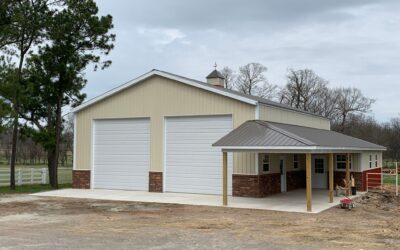

When you’re planning to build a pole barn in Oklahoma, one of the most critical questions is: How much is this actually going to cost? Without a clear understanding of costs you’ll risk budget overruns, delays, and frustration. At Bradford Buildings we’ve helped dozens of Oklahoma landowners build dependable, high‑value pole barns—and we want to give you a detailed, no‑nonsense breakdown of what to expect, how to plan, and what you can do today to control cost without sacrificing quality.
The Cost Spectrum: From Shell to Fully Finished
Pole barns aren’t one‑size‑fits‑all. The cost depends heavily on how you plan to use the structure, how much finishing it will have, and what site conditions you face in Oklahoma or NW Arkansas.
For example:
- A “basic shell” that serves for storage might cost $15 to $40 per square foot. (HomeGuide)
- A fully finished pole barn—with workshop space, offices or living quarters—can exceed $60 to $150+ per square foot, especially when you factor in climate control, higher end finishes and heavy‑duty equipment storage. (Delmarva Buildings)
- One kit‑pricing guide lists base pricing starting at $6,000 for very small builds and up to $200,000+ for large custom barns. (Hansen Buildings)
What this tells you: there is no fixed “average cost” until you define your size, use, finish level, and site. That’s why at Bradford Buildings we begin each project with a budget check‑in and site evaluation so we avoid surprises and you stay in control.
Size Matters—Big Builds Can Give Better Value
As you scale up size, your cost per square foot often drops because many costs are fixed or semi‑fixed (engineering, foundation prep, site access). For example:
- For small storage builds, you may see costs at the high end of the $15‑$40/sq ft range.
- For larger ones (say 40×60 or bigger), you might see the lower end of that range because the overhead is spread over more area.
- If you add full living space or workshop finishes, the cost rises again.
What you should ask yourself: “What will I actually use this barn for five years from now?” If you build only for minimal use, you may limit future options. At Bradford Buildings we help you answer that by showing multiple budget scenarios: basic shell vs. finished vs. multi‑purpose. That way you know what the cost difference is and can make a smart decision.
Key Cost Drivers: What Moves the Needle
There are several elements that can significantly raise (or lower) your final cost. Understanding these will give you leverage when you sit down with your builder.
1. Site Preparation & Site Conditions
If your land needs major grading, clearing, or has poor soil, those costs can add up. For example:
- Sloped lots or heavily wooded sites may need tree removal, retaining walls, or added fill.
- Rocky soil or poor compaction means deeper or upgraded footings.
- Driveway or access improvements may be required to bring in equipment.
Some guides list site prep as one of the most underrated cost factors in a barn build. (FBi Buildings)
Bradford Buildings always begins with a site visit in Oklahoma/NW Arkansas. We assess land condition, drainage, access, and help you budget for site work before materials and labor begin—so you aren’t caught off guard.
2. Foundation & Slab
While pole barns often require less concrete than traditional buildings, you still need a properly designed pad for durability. A quality concrete slab might cost $5‑$10 per square foot depending on thickness, reinforcement and local conditions. (HomeGuide)
At Bradford we’ve seen clients underestimate this and then face uneven floors or moisture issues that ripple into other costs.
3. Building Shell and Structural Frame
The posts, trusses, roof and siding define the core cost. Materials matter (quality of steel, gauge, finishes) and so does engineering (wind load, snow load, span).
For example, some cost guides show kits from $15‑$30 per square foot just for the shell. (Delmarva Buildings)
Bradford uses post‑frame systems engineered for Oklahoma’s wind and weather. That matters for longevity and for avoiding cost escalations when local inspectors require upgrades.
4. Doors, Windows & Specialty Features
Roll‑up doors, large clear‑span openings, specialty windows, lofts, mezzanines—all of these add cost. Each extra large door adds thousands of dollars; each glazing or higher ceiling adds more labor and materials.
One guide notes: “Fully finished barns with living quarters or heavy workshop use can cost $40‑$110 per square foot or more.” (HomeGuide)
At Bradford Buildings we help you prioritize which features matter most so your budget goes to the items that deliver value.
5. Utilities, HVAC & Interior Finish
If you plan to heat or cool the space, add plumbing, or finish it for human use (not just storage), your cost jumps. A basic storage barn is far cheaper than a climate‑controlled workshop or living space.
One cost guide cites finishing costs (insulation, drywall, utilities) ranging from an added $35‑$110 per square foot. (HomeGuide)
We at Bradford work with trusted subcontractors in Oklahoma‑Arkansas to price out mechanical systems and help you avoid hidden surprises in your build.
6. Labor, Permits & Local Conditions
Material supply chains, local labor availability, permit complexity and delivery logistics all affect cost. In rural Oklahoma or NW Arkansas, delivery distance or site access may add premium.
The 2025 cost guides demonstrate region matters: Oklahoma barndominiums are estimated $62‑$152 per square foot depending on finish level. (Delmarva Buildings)
Bradford Buildings handles permitting and local logistics for you, keeping cost estimates firm and realistic.
Realistic Budget Scenarios for Oklahoma
To make this practical, let’s look at three scenarios you might realistically face in Oklahoma or NW Arkansas—and what they cost. These are illustrative; your exact quote will vary based on local conditions and choices.
Scenario A: Basic Storage Barn
- Size: 30’ x 40’ (1,200 sq ft)
- Purpose: equipment and vehicle storage only, minimal finish
- Site: flat, already cleared land
- Shell: basic post‑frame, metal siding, one roll‑up door and one walk door
- No HVAC, minimal lighting, no insulation
Estimated cost: On the shell end of $15‑$30 per square foot → roughly $18,000 to $36,000 based on national data. (HomeGuide)
In Oklahoma, site and delivery may bump that higher modestly, but using a local builder like Bradford Buildings helps keep the premium lower.
If you’re looking for cost‑effective storage on your property, this scenario is common and dependable.
Scenario B: Workshop + Storage Hybrid
- Size: 40’ x 60’ (2,400 sq ft)
- Purpose: work shop with vehicle storage and basic utility space
- Site: rural Oklahoma lot, moderate prep needed
- Shell: post‑frame with larger roll‑up doors, some insulation, LED lighting
- HVAC: minimal (maybe heat only)
You may see cost range $25‑$45 per square foot for this type of build in your region depending on customization. Combining shell + some finish = estimated $60,000 to $110,000. Use of higher features or finished areas could push it further.
As one guide noted: a 40×60 pole barn with features ran $36,000‑$96,000 in one estimate. (HomeGuide)
With Bradford Buildings, we walk you through control points so you decide where to spend (doors, insulation, lighting) and where to hold back—and still get a durable workshop.
Scenario C: Fully Finished Barndo/Hybrid Living + Shop
- Size: 50’ x 80’ (4,000 sq ft)
- Purpose: living quarters + shop/storage + loft/mezzanine
- Site: rural acreage in NW Arkansas or Oklahoma, needs grading, utilities run
- Shell: premium post‑frame, high ceilings, high‑grade siding and roofing, many and large openings, multiple doors
- Finish: residential‑grade floors, mechanical HVAC, full bathrooms, kitchen, insulation, lighting, potentially loft/office
This scenario can run $60‑$150+ per square foot depending on finish level. One recent data set for Oklahoma barndominiums estimated $62‑$152/sq ft. (Delmarva Buildings)
For 4,000 sq ft at the low end ($62) you’re looking at roughly $248,000. At the high finish end ($150) you’re looking at $600,000+.
Bradford Buildings specializes in precisely this kind of build—where your barn becomes functional living space, workshop, and storage all in one. We factor in utility runs, code compliance, and design flexibility so your cost reflects value, not surprises.
How to Control Cost Without Sacrificing Value
You don’t have to accept runaway budgets. Here are practical ways to manage your cost while still achieving a high‑quality build.
Choose the Right Size for Your Needs
Oversizing just because you can is a cost trap. At Bradford we help clients forecast what they will use in 5‑10 years, and build accordingly—not just guess. That means spending money where it counts (doors, structure, finish) and avoiding wasted square footage.
Prioritize Key Features
Focus on the features that deliver the most utility: large doors for equipment, solid insulation if you’ll be inside, quality metal siding for durability. A longer list of custom windows, lofts, or aesthetic touches can add up fast. Bradford helps you rank features by value.
Simplify Floor Plan & Finishes
A rectangular footprint, fewer interior walls, standard door sizes, and simpler finishes all save money. If you don’t need full residential grade workmanship, skip the extras and build for utility now—with the option to upgrade later. Our builds with Bradford often use that phased approach.
Site‑Prep Smart
An accessible site, minimal clearing and flat terrain all reduce cost. High slopes, heavy clearing, long utility runs and poor soils add cost fast. If you’re buying land, ask Bradford for a “site readiness” check so you know what you’re really buying—site cost surprises are common.
Bundle Materials & Labor with One Builder
When you go with separate contractors for every part, coordination adds cost and risk. Bradford Buildings handles the full build—from site evaluation to shell to finish—so you avoid gaps, extra markups, and timeline delays.
Get Transparent Estimates
Ask for line‑item breakdowns: shell cost, doors/windows, slab, utilities, finish. Compare apples to apples. When you see “mystery numbers,” you lose control. At Bradford we provide detailed quotes and walk you through each category so you know where the money is going.
Financing, Timing, and Hidden Costs
Building a pole barn involves more than just paying your builder. Here are some often overlooked cost and timing factors.
Permits, Inspections & Local Code
Permits may cost a few hundred to a few thousand dollars depending on county. If the structure will be turned into living space, residential codes apply, which could add cost. One guide notes that costs vary by location and usage. (Angi)
Bradford Buildings handles permit coordination across Oklahoma and NW Arkansas so you don’t absorb surprise fees or delays.
Utility Connections and Infrastructure
If you need to run electrical service, water or septic systems or upgrade your driveway and site access, budget extra. One article cited utility runs in finished pole barns adding significant cost. (HomeGuide)
We work with regional partners to quote utility runs early so you’re not surprised.
Material Price Volatility
Steel, lumber, labor and fuel prices fluctuate. One source points out that material pricing can swing widely and builders’ quotes may only hold for a short time. (FBi Buildings)
When you work with Bradford you’ll receive a timeline and pricing window so you can lock things or plan contingency.
Resale Value and ROI Considerations
While many pole barns are built for utility, if you ever sell the property you’ll want to consider how buyers view the structure. A fully finished, code‑compliant building will hold value more than a cheap shell built just for storage. If resale is in your plan, factor in quality up front.
At Bradford we discuss your long‑term plans—whether you intend to stay, rent, or sell—and build accordingly.
Why Bradford Buildings Is the Right Builder for Your Budget
Choosing a good builder isn’t just about lowest bid—it’s about delivering value, avoiding hidden costs, and staying on schedule. Here’s how Bradford Buildings stands out:
- We’ve built hundreds of pole barns and metal buildings across Oklahoma and NW Arkansas, so we know the regional cost drivers, permit decks and site issues.
- We provide upfront, transparent estimates—so you understand what you’re paying for and can make informed decisions.
- We help you lock in key decisions early (size, design, finishes) and avoid change orders that often inflate cost late in the build.
- We partner with trusted regional subcontractors and suppliers so delivery, materials and labor are reliable—reducing delay‑cost risk.
- We work with you throughout the build—from site prep to final walk‑through—so you have one builder accountable for both cost and quality.
If you’d like a detailed cost estimate for your specific property (in Oklahoma or NW Arkansas), we’d be happy to walk the land, evaluate access, utility runs, and build options. You’ll leave with a clear budget scenario: shell only, workshop finish, or full living space. No surprises. No fluff. Just smart building.
Building a pole barn is a major investment—and it should build towards your goals, not away from them. Whether you need a straightforward storage building or a fully equipped workshop or even a hybrid living‑space, the cost is real—but so is the value when you get it right. At Bradford Buildings we’ll help you map the cost today and build the value tomorrow.